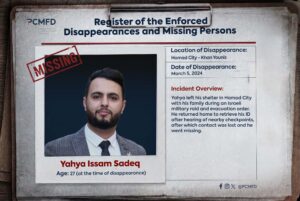
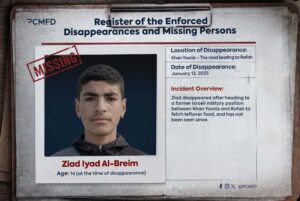
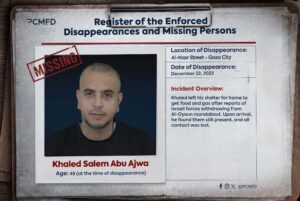
Three years since the outbreak of hostilities in the Gaza Strip, a compounding crisis of missing persons, enforced disappearances, and unaccounted-for individuals continues to leave thousands of families without answers regarding the fate of their loved ones, the Palestinian Center for Missing and Forcibly Disappeared said in a statement. The Center emphasized that after three years, effective and immediate international action is urgently required to clarify the status of the missing, determine their whereabouts, and uphold families’ right to the truth.
According to the Center’s documentation, case tracking, and witness testimonies, an estimated total of more than 7,000 individuals remain missing across the Gaza Strip. Among them, approximately 4,000 are believed to be trapped beneath rubble, while over 2,500 are suspected victims of enforced disappearance carried out during the conflict.
The Center highlighted that the crisis of the missing and forcibly disappeared constitutes one of the most severe human rights and humanitarian fallouts of the war, particularly given the total absence of official information, which leaves families unable to determine whether their relatives are living, detained, or deceased.
Hundreds of documented cases involve individuals who disappeared in border areas following October 7, 2023, under circumstances where their families were unable to ascertain what happened to them. Information gathered by the Center indicates that several of these missing persons were minors under the age of 18, while others had traveled toward border zones out of curiosity before communications were entirely severed.
Families face immense difficulty determining whether their relatives lost their lives in the area, were detained, or were transferred elsewhere. In all cases, families have received no official information to date regarding their relatives’ fate.
The Center stressed that the lack of credible information three years on demands prompt, effective search and investigative efforts, noting that disappearances did not cease with the initial hostilities but persisted continuously through, and following, the announced ceasefire on October 9, 2025.
The statement directly noted that Israeli occupation authorities have utilized enforced disappearance as a systematic policy during the war, employing it as a tool of collective punishment and pressure on Palestinians by denying families basic information regarding the fate of their loved ones.
The Center grounded this assessment in the persistent refusal by Israeli authorities to release comprehensive lists of Palestinian detainees held in its prisons, as well as the failure to disclose the fate of persons who disappeared in border regions, whether deceased or detained.
It also highlighted ongoing restrictions on prison visitations that prevent direct family communication, combined with the return of hundreds of retained bodies without sufficient information or documentation to permit identification or determine their cause of death.
The Center warned that withholding such information and preventing families from obtaining answers severely hampers documentation and search initiatives, while doubling family trauma and prolonging years of acute uncertainty. It noted that continuing this course, while holding knowledge of detained or deceased individuals, constitutes a deliberate means to deepen family suffering and inflict psychological punishment.
Concurrently, thousands of families remain in anguish regarding relatives believed to be buried under collapsed infrastructure, amid ongoing restrictions on the entry of heavy equipment necessary for search and recovery operations. This blockade prevents access to human remains, their identification, and their dignified burial, keeping families in a state of continuous waiting and uncertainty.
The Center reiterated that a family’s right to know the fate of missing relatives is not merely a humanitarian demand, but an explicit right protected under International Humanitarian Law. Article 32 of Additional Protocol I (1977) to the Geneva Conventions establishes that the implementation of provisions regarding missing and deceased persons must be driven primarily by “the right of families to know the fate of their relatives.” Article 33 further obligates parties to a conflict to search for persons reported missing and to exchange relevant data to facilitate search efforts.
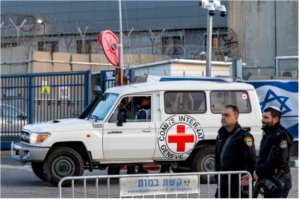
In addition, the Fourth Geneva Convention of 1949 contains provisions regarding information on protected persons, mechanisms for transmitting such data, and responding to inquiries. The International Committee of the Red Cross includes Article 26 of the Convention among the core legal provisions governing the issue of missing persons and their families.
Under these binding rules, families must not be left without information, and conflict parties bear the responsibility to take all necessary measures to locate missing persons, determine their fate, and provide families with available information.
Through direct engagement with hundreds of affected families, the Center observed that all suffer from severe, continuous psychological and mental health impacts. Constant uncertainty over whether a relative is alive or dead subjects family members to persistent anxiety, severely impairing their daily lives. In several cases tracked by the Center, parents suffered physical and mental health deterioration stemming from prolonged exhaustion and relentless searching for any answers.
The Center emphasized that this suffering does not end with the passage of time, but worsens as the absence of information persists, especially when families lack access to a clear answer or official investigative path.
The Palestinian Center for Missing and Enforced Disappeared Persons demanded that Israeli occupation authorities immediately disclose information regarding all Palestinians missing during the war, release the names and detention locations of detainees, and grant specialized international bodies access to them.
It called for clarifying the fate of all persons missing in Gaza’s border areas since October 7, 2023, determining whether they were killed or detained, and providing information on their whereabouts or circumstances of death.
The Center urged that humanitarian and rights organizations be granted access to detention facilities, that families’ right to information be ensured, and that effective mechanisms be provided to locate, identify, and return human remains to their families.
It further called on the international community to assume its responsibilities regarding the missing persons crisis in Gaza and establish an independent, effective mechanism to investigate cases of loss and enforced disappearance, collect evidence, and determine the fate of those whose families await answers.
The Center affirmed that the passage of three years does not diminish the legal right of any family to the truth, nor does it absolve any party of its responsibility to search for the missing. For thousands of families in Gaza, the war has not ended with the cessation of fighting, as the fate of their loved ones remains unknown and their right to know the truth remains unfulfilled.