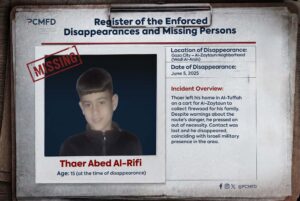
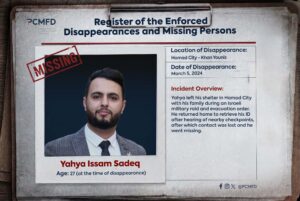
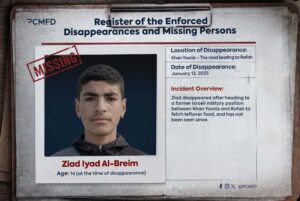
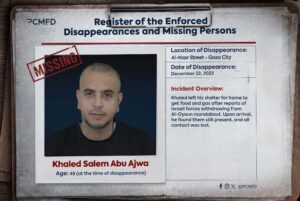
In official letters addressed to the Foreign Ministers of European Union member states on the occasion of World Children’s Day, the Palestinian Center for the Missing and Forcibly Disappeared called for effective diplomatic and legal pressure on Israel to disclose the fate of approximately 2,900 missing children in the Gaza Strip. These children disappeared during the Israeli war on Gaza under circumstances linked to bombardment, military operations, starvation, and the total deprivation of basic necessities, amid an ongoing absence of information regarding their whereabouts—including cases documented even after the ceasefire took effect.
In a statement issued today, the Center noted that its letters to European ministers detailed the tragedy of child disappearances in Gaza and urged immediate action to compel Israeli authorities to reveal the fate of detained children and grant the International Committee of the Red Cross (ICRC) access to visit them. The Center also called on the EU to work toward facilitating the entry of heavy machinery and fuel required to enable rescue teams to recover children trapped beneath the rubble.
The Center emphasized the necessity for European governments to support independent investigations into cases of missing children, ensure accountability for violations committed against them, and move beyond mere statements of concern and condemnation, as families continue to be denied their fundamental right to know the fate of their children.
According to the Center, thousands of families in Gaza remain trapped in agonizing uncertainty, not knowing whether their children are alive, buried beneath the rubble of their destroyed homes, or held in Israeli detention facilities.
Tracing the circumstances preceding and surrounding these disappearances reveals the immense hardship and extreme living conditions imposed on these children. Throughout the war, systematic starvation and abject poverty forced many to venture into high-risk areas in search of food or flour to feed their families, or to gather firewood to meet basic household needs.
The Center pointed out that a significant number of these children had already lost their fathers or older siblings during the war, thrusting the burden of supporting their families onto their shoulders at a tender age and forcing them to risk their lives. Additionally, the Center documented cases of children sneaking back to check on their homes in areas experiencing active military operations—driven by the harsh realities of displacement, loss of shelter, and a longing to inspect their homes and belongings—reflecting the total absence of protection children have endured throughout the war.
The Center further highlighted that the coercive conditions imposed by the Israeli military during the war, whose repercussions persist even after the ceasefire, have led to continued disappearances. Specifically, the Center documented the cases of two children under the age of five who went missing after the ceasefire announcement near the “Yellow Line”—the military buffer zone separating areas under Israeli military control from populated areas.
The Center clarified that the families of these children did not choose to live near this perilous zone; rather, they were forced to pitch their tents there due to the acute shortage of space in the Gaza Strip and the complete absence of available rental housing or safe shelter alternatives, amidst a reality devoid of the bare minimum requirements for stability. Several other families reported their children missing in the same area, though they were fortunately able to locate and reach them at the last moment.
Based on its estimates and documentation, the Center stated that approximately 2,900 children remain missing in the Gaza Strip. Of these, roughly 2,700 are believed to remain trapped under the rubble of destroyed buildings, as recovery efforts have been paralyzed by the severe shortage of heavy equipment and fuel, alongside strict access restrictions to affected areas. Meanwhile, contact has been lost with around 200 children across various parts of the Strip, raising grave fears that some have been subjected to enforced disappearance by Israeli military forces, or that their bodies were lost due to direct targeting and the inability to reach the sites.
The statement added that several disappearances are linked to serious concerns that children were abducted and detained without disclosure of their whereabouts or fate, particularly near aid distribution centers and areas under Israeli military control. The Center noted that documented figures may underrepresent the true scale of the crisis, as many families remain reluctant to file formal missing-person reports out of fear of persecution or targeting. It reiterated the imperative to disclose the fate of all detained children, guarantee their protection, and enable the ICRC to visit them and verify their conditions.
The Center stressed that the tragedy of missing children does not end with their disappearance, but extends to their families, who endure an open-ended wait—torn between continuing the search for their children and confronting the prospect of their loss.
It explained that Civil Defense crews and rescue teams remain largely powerless to recover bodies from beneath the debris, able to retrieve only a fraction of the victims due to the breakdown of most heavy machinery and Israel’s continued blockade on the entry of necessary equipment and vehicles into the Strip. This threatens to leave the bodies of these children buried under the rubble for years to come unless urgent international intervention secures the entry of required machinery—placing their families, or whoever remains of them, in a state of perpetual terror of losing their children’s remains forever and being denied their basic right to know the truth and afford them a dignified burial.
In conclusion, the Center affirmed that protecting children in armed conflicts is not merely a moral obligation, but a binding legal duty under International Humanitarian Law and the Convention on the Rights of the Child. It underscored that the right of families to know the fate of their loved ones, and the right of children to protection, life, and dignity, must never remain suspended or subject to indefinite delay.